


Brake Drum Types: Durable, Precision-Fit, Fast Shipping
If you’ve ever argued about brake drum types in a fleet garage at 6 a.m., you know it gets surprisingly passionate. Drums aren’t flashy like discs, but they keep winning in heavy trucks, trailers, buses, and plenty of rear axles because they’re tough, predictable, and—let’s be honest—budget-friendly.
Industry trend? Two tracks. Passenger cars quietly migrate to discs on all corners; meanwhile, commercial vehicles double down on high-carbon gray iron drums with better ribbing for stiffness, tighter balance, and coatings to fight rust-welded wheels. ECE R90 approvals for replacement drums are becoming table stakes in Europe, and fleets keep asking for lighter drums that don’t crack under heat. Not easy, but progress is real.
What kinds of drums are people actually buying?
- Standard gray iron (SAE J431 G3000 / ASTM A48 Class 35): the everyday workhorse.
- Heavy-duty ribbed/ventilated: thicker walls, deeper ribs, better heat rejection for mountain routes.
- Composite (cast iron liner + aluminum shell): niche, weight-saving; watch thermal fatigue.
- Ductile iron: tougher against impact; pricier; used in off-highway and mining.
- Hubbed vs. hubless (standalone): trailer builders care—assembly time vs. service flexibility.
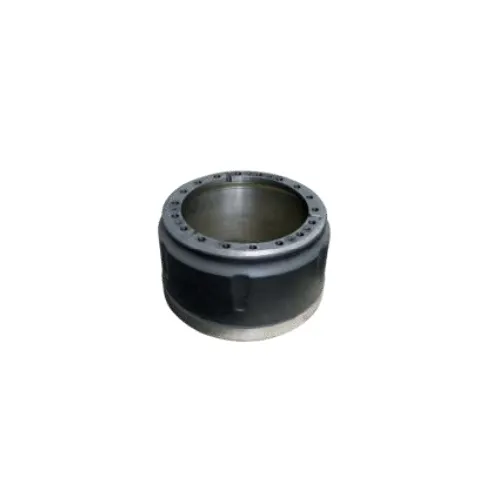
Materials, process, and testing (how good drums get made)
From Tang County Economic Development Zone, Chang Gu Cheng Industrial Park (Ba Qie), Hebei, China, I’ve watched foundries run this flow: charge selection (pig iron + scrap + alloy), induction melting, inoculation, sand molding, controlled pour, shakeout, stress relief, CNC finish, dynamic balance, and paint. The better factories lock chemistry for pearlitic gray iron (≈3.1–3.4%C; 1.8–2.2%Si) with trace Mo/Cr for heat stability. Testing? Brinell hardness mapping (aim ~190–240 HB), runout, microstructure, and hot judder trials on dynos. For air-braked axles, FMVSS 121 performance downstream is the north star; in Europe, R90 conformity for replacement drums matters more every year.
Representative product specs
| Material | SAE J431 G3000 / ASTM A48 Class 35 (options: alloyed, ductile) |
| Outer diameter range | 230–470 mm (custom up to ≈520 mm) |
| Hardness | ≈190–240 HB; uniformity ±15 HB across track |
| Runout (machined) | ≤0.08 mm typical (real-world use may vary) |
| Balance grade | ISO 1940-1 G16 or better; trim weights as needed |
| Service life | ≈150,000–500,000 km (route, load, and lining choice dependent) |
Applications and feedback
- Linehaul tractors and trailers (heat cycles, long descents).
- City buses and refuse trucks (stop‑start abuse; squeal control).
- Off‑highway, ag, and mining (impact, mud, corrosion).
Many customers say heavy‑duty ribbed drums cut fade complaints on summer routes. A fleet ops manager told me, “Switching to high‑carbon spec drums halved our hot judder returns.” It’s anecdotal, sure, but it tracks with dyno data I’ve seen.
Vendor comparison (quick take)
| Vendor | Material control | Certifications | Lead time | Customization |
| Kaihua Casting (Hebei) | Spectro + hardness mapping | ISO 9001; IATF 16949 available on request | ≈25–40 days after tooling | Ribbing, coatings, balance, private mold |
| Global Brand A | Advanced SPC; traceability | IATF 16949, ECE R90 program | ≈30–60 days | Full automotive APQP |
| Value Supplier B | Basic chem + spot checks | ISO 9001 | ≈20–35 days | Limited options |
Customization notes
For brake drum types in severe duty, ask for: higher Mo content, extra ribbing, corrosion‑resistant paint on the pilot/face, and ISO 1940 G16 balancing. For trailers, hubbed vs. hubless decisions change service time—worth a talk with your axle OEM.
Case in point
A Sichuan mountain‑route fleet moved from generic drums to alloyed gray iron with deeper fins. Result over 9 months: rotor (drum) temperature peaks down ≈25–35°C on comparable descents, crack returns effectively zero, and shoe life up ~12%. Not a lab paper, but the logs looked solid.
Standards and references:
- SAE J431: Automotive Gray Iron Castings.
- ASTM A48: Gray Iron Castings.
- ISO 1940-1: Mechanical vibration—Balance quality of rigid rotors.
- FMVSS 121: Air Brake Systems (heavy vehicles).
- UNECE Regulation No. 90 (R90): Replacement brake components (discs/drums, linings).
- IATF 16949: Automotive Quality Management Systems.