


High Performance Auto Parts—Faster, Tougher—Shop Now?
Axle Thrust Rod Seats: The quiet hero under heavy trucks
If you follow commercial vehicle hardware the way I do, you already know the market for high performance auto parts is getting smarter, not just tougher. Axle thrust rod seats—yes, those unglamorous brackets—carry enormous loads, keep alignment in check, and frankly decide whether a fleet burns money on tires and downtime. This piece draws on shop-floor chats, lab data, and a few miles of road grit to unpack what matters right now.
What it is and why it matters
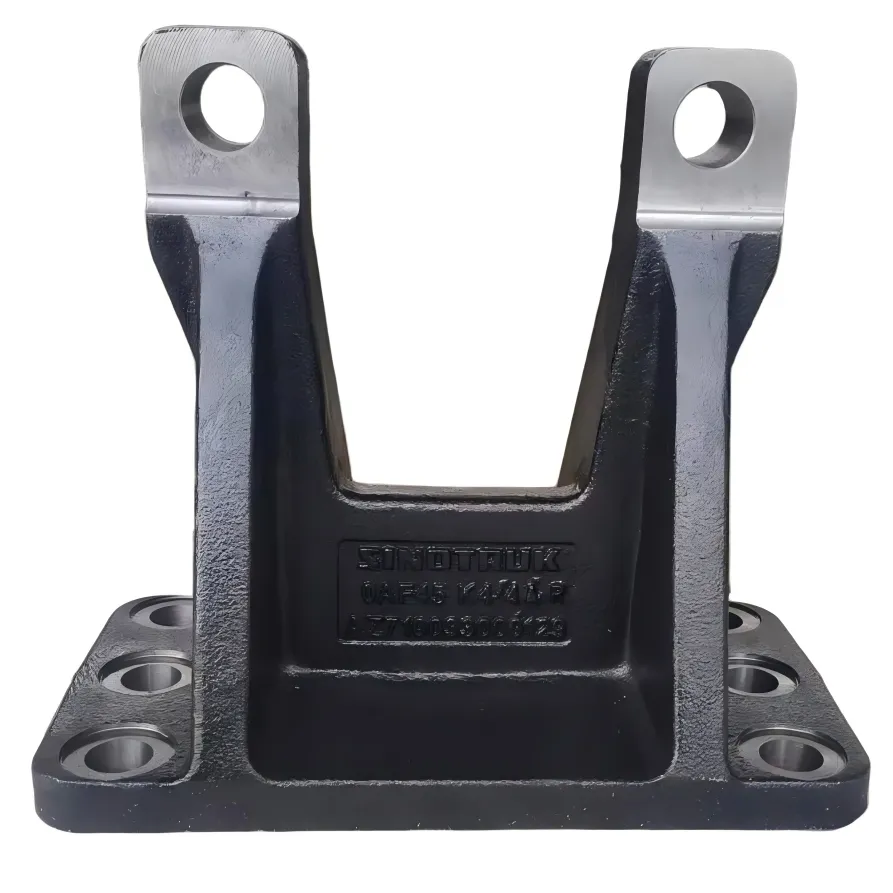
The axle thrust rod seat anchors the torque/track control rod between the axle and chassis. It sees bending, shear, and torsional pulses every time a loaded trailer hits a patch of rough tarmac. In fact, it’s the pivot that stabilizes handling and protects bushings. Many customers say a better seat cuts irregular tire wear and keeps steering truer over long-haul duty. Sounds simple; it isn’t.
Industry trends I’m seeing
- Electrified heavy trucks increase instantaneous torque spikes—mounts need higher fatigue strength.
- Lightweighting is real, but durability still rules. Smart geometry beats thin castings.
- Corrosion resistance is non-negotiable for fleets crossing coastal routes or salted roads.
- Total cost of ownership: fleets want longer service life and predictable alignment intervals.
Axle Thrust Rod Seats — Product specs (real-world centric)
| Parameter | Specification | Notes |
|---|---|---|
| Base material | Ductile iron (ASTM A536 70-50-05) | Alternative: QT500-7 (GB/T 1348) |
| Process | Resin sand casting + CNC machining | CMM-verified |
| Heat treatment | Normalizing | Controls pearlite/ferrite balance |
| Surface finish | E-coat or epoxy powder | Salt spray ≥ 480 h (ISO 9227) ≈ |
| Dimensional tolerance | ISO 8062-3 CT8 | Machined features tighter |
| Hardness | ≈ 170–230 HBW | Brinell; batch-dependent |
| Yield strength | ≈ 345 MPa | Typical for 70-50-05 |
| Fatigue life | ≈ 1.5–2.0 million cycles | ASTM E466 axial, lab; use may vary |
| Operating temp | -40 to 120 °C | SAE J1455 thermal profile |
| Bushing interface | Press-fit seat, Ra ≤ 1.6 μm | Concentricity ≤ 0.05 mm |
| Certification | IATF 16949 | Automotive QMS baseline |
| Origin | Tang County Economic development zone, Chang Gu Cheng Industrial Park (Ba Qie), Hebei, China | Factory direct |
Process flow (what actually happens on the floor)
Metallurgy selection → Pattern and mold build → Melting and pouring → Shakeout → Heat treatment → CNC machining → Shot-blast → Coating → Bushing seat finishing → 100% critical-dimension inspection (CMM) → Salt spray and fatigue testing → Pack and ship. To be honest, the CMM step saves more warranty claims than people think.
Application scenarios
- Long-haul tractors carrying high GCWR trailers
- City buses and coaches—NVH and ride control matter
- Quarry and construction haul trucks—abrasive environments
Vendor comparison (what fleets usually ask me)
| Vendor | Testing | Dimensional control | Coating durability | Customization |
|---|---|---|---|---|
| KAIHUA Casting | Fatigue + ISO 9227 | CMM, CT8 or better | ≈ 480–720 h | Drawings, alloys, finishes |
| Generic Foundry A | Basic visual | Gauge-only | ≈ 240 h | Limited |
| Trading Co. B | Supplier-declared | Varies | Unknown | Depends on OEM |
Customization and real-world feedback
Options include alloy tweaks for low-temp toughness, e-coat thickness targeting, and bushing seat tolerances for different rod suppliers. A logistics fleet in Southeast Asia reported ≈18% fewer suspension-related service calls after switching—mostly due to tighter bushing seating and better corrosion protection. Anecdotal? Sure. But it lines up with shop measurements I’ve seen.
Advantages you can feel on the road
- Stabler alignment under load, improved tire life
- Predictable handling—less steering fight on broken pavement
- Longer service intervals; around 1–2 million cycles in lab testing
If you’re spec’ing high performance auto parts for buses or heavy-haul fleets, a robust thrust rod seat is the quiet upgrade your drivers will thank you for. And if you source high performance auto parts globally, origin and standards matter—ask for IATF 16949 paperwork and real test data, not just brochures.
Standards referenced
- IATF 16949: Automotive Quality Management System
- ASTM A536: Standard Specification for Ductile Iron Castings
- ISO 8062-3: Dimensional and geometrical tolerances for castings
- ISO 9227: Corrosion tests in artificial atmospheres — Salt spray tests
- SAE J1455: Recommended environmental practices for electronic equipment design (thermal/corrosion profiles often referenced for vehicle components)
- ASTM E466: Standard Practice for Conducting Force Controlled Constant Amplitude Axial Fatigue Tests