Email: info@kaihuacasting.com
Tel: +86-0312-3039759


The global automotive supply chain is currently undergoing a significant transition as OEMs shift toward more modular and specialized component sourcing. Within this ecosystem, car parts manufacturing companies are increasingly required to balance traditional mass-production efficiency with the precision demanded by next-generation transmission and braking systems.
This evolution is driven by the need for higher material durability and tighter tolerances to reduce energy loss and noise, vibration, and harshness (NVH). For engineers and procurement managers, the challenge lies in identifying partners capable of maintaining structural integrity under extreme mechanical stress while adhering to stringent international quality standards like IATF16949.
This analysis explores the critical engineering requirements for automotive drivetrain and chassis components, examining how advanced casting and machining processes resolve common reliability failures. We will evaluate the selection criteria for high-performance housings and components to help technical buyers optimize their supply chain.


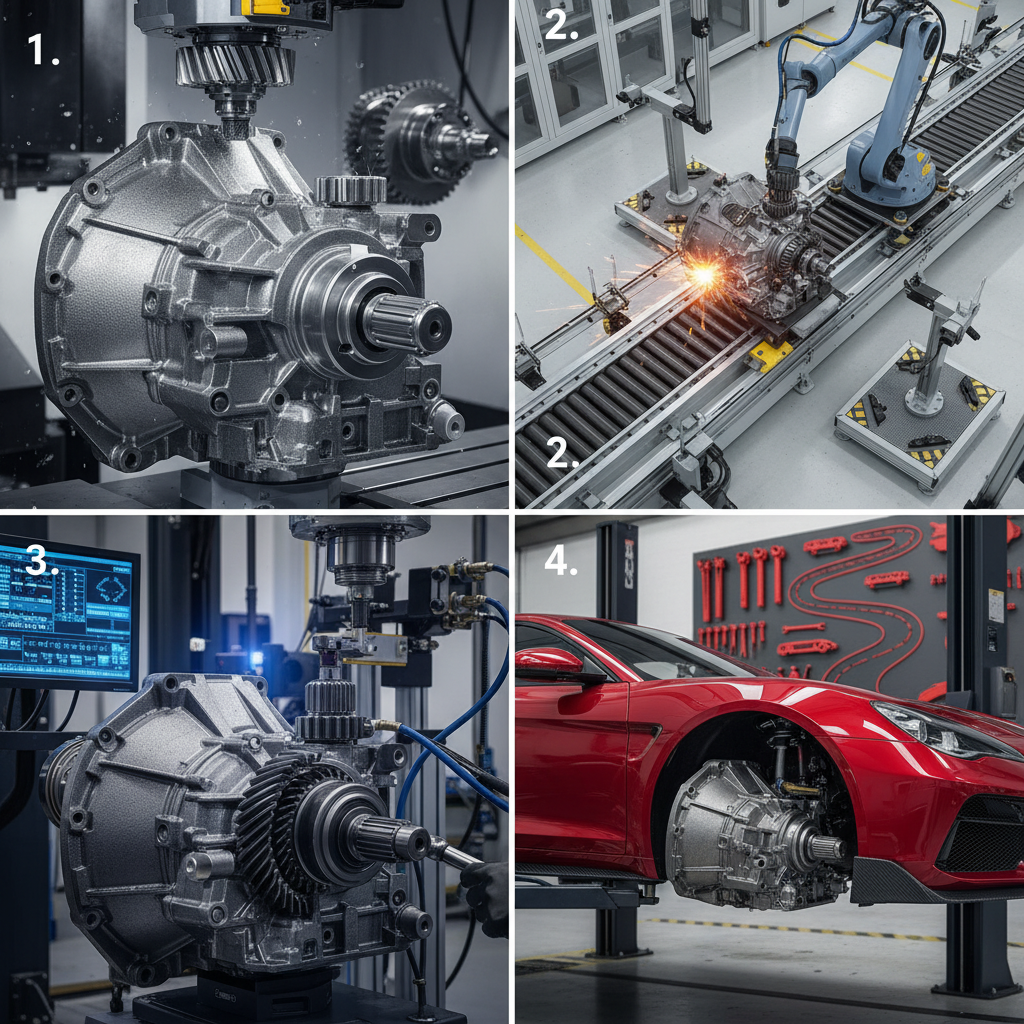
The core function of any transmission housing is to maintain the precise axial and radial alignment of gears and bearings. Any deviation during operation leads to uneven wear, increased friction, and eventual mechanical failure. Professional car parts manufacturing companies focus on the ribbing structure and wall thickness to optimize the strength-to-weight ratio.
Beyond structural support, the housing must act as an efficient heat sink. In high-torque applications, thermal management is critical to prevent lubricant degradation. Integrating optimized cooling fins and ensuring high thermal conductivity in the base material are standard engineering practices to extend the lifespan of the internal gearing.
Material selection is dictated by the specific stresses of the application. Ductile iron is frequently utilized for its superior shock absorption and wear resistance, making it ideal for heavy-duty automotive and construction machinery parts. Its ability to withstand cyclic loading without developing fatigue cracks is a primary reason for its dominance in chassis and drivetrain housings.
For applications where weight reduction is paramount, aluminum alloys provide a viable alternative, offering high strength-to-weight ratios and excellent corrosion resistance. However, the trade-off often involves lower absolute wear resistance compared to iron-based materials, requiring the use of precision inserts or specialized coatings at high-friction contact points.
Steel-reinforced designs are reserved for the most extreme environments, such as heavy-duty commercial vehicle axle components. These materials are engineered to handle peak torque loads that would otherwise deform standard castings, ensuring that the geometry of the power transmission system remains stable under maximum load.
Casting is only the first step; the final performance of a component is determined by the CNC machining process. Ensuring tight tolerances for bearing seats and mating surfaces is non-negotiable. Even a few microns of misalignment can cause parasitic power loss and accelerate the wear of synchronized gears.
Furthermore, the application of corrosion-resistant coatings and precision sealing surfaces prevents lubricant leakage. In environments exposed to mud, salt, and moisture, the integrity of the gasket surface determines whether the internal components remain protected or suffer from premature contamination.
Evaluating the reliability of automotive components requires a multi-dimensional approach. Factors such as fatigue strength, thermal stability, and impact resistance are measured against a normalized scale to determine the suitability of a part for a specific duty cycle.
While high-precision parts offer superior efficiency, they may be more susceptible to extreme shock loads compared to more robust, heavier castings. The engineering goal is to find the "optimal equilibrium" where the part is light enough for fuel efficiency but strong enough for the intended operational lifespan.
In the realm of commercial vehicle parts, the operational environment is significantly more aggressive than in passenger cars. Components such as brake system housings and axle casings must endure constant high-torque demands and exposure to corrosive road agents. The deployment of ductile iron components in these scenarios ensures that the parts can absorb vibration without compromising the alignment of the drivetrain.
Beyond the road, these manufacturing capabilities extend to construction and agricultural machinery. For instance, gearbox housings in tractors must operate in dust-heavy and high-moisture environments. The use of sealed bearings and reinforced casting walls prevents the ingress of debris, which is the leading cause of internal gear failure in off-road equipment.
The industry is moving toward "intelligent casting," where simulation software predicts thermal contraction and potential porosity before the mold is ever poured. This allows car parts manufacturing companies to reduce material waste and ensure a more uniform grain structure throughout the component.
Another significant shift is the integration of hybrid material joins, where high-strength steel is cast or bonded into aluminum structures. This approach allows engineers to place the strongest materials only where the highest stress occurs, reducing the overall vehicle curb weight without sacrificing safety or durability.
Looking forward, the adoption of additive manufacturing for prototyping and low-volume specialized parts is accelerating. While traditional casting remains the standard for mass production due to cost-efficiency, 3D metal printing is enabling the creation of internal cooling channels that were previously impossible, potentially revolutionizing thermal management in high-performance drivetrain components.
Selecting the right manufacturing partner and material configuration depends on a technical trade-off analysis. A part optimized for weight may fail under extreme shock, while a part optimized for durability may be too heavy for fuel-efficiency targets.
Procurement teams should evaluate manufacturers based on their certification (such as ISO9001 and IATF16949) and their capacity for end-to-end production, from induction melting to precision CNC finishing. This vertical integration reduces the risk of tolerance stack-up errors.
The following matrix provides an engineering framework for matching component configurations to specific operational profiles, ensuring that the chosen specification aligns with the intended application.
| Configuration Profile | Primary Material | Key Performance Factor | Recommended Use Case |
|---|---|---|---|
| Basic Duty | Standard Gray Iron | Cost Efficiency | Light Commercial/Utility |
| Standard Duty | Ductile Iron | Vibration Damping | Passenger Vehicle Chassis |
| High-Duty | Reinforced Ductile Iron | Fatigue Resistance | Heavy-Duty Truck Axles |
| Precision Profile | Aluminum Alloy | Weight Reduction | High-Performance Drivetrains |
| Extreme Load | Steel Reinforced | Peak Torque Stability | Construction Machinery |
| Industrial Baseline | Mixed Alloy | Versatility | General Purpose Gearboxes |
Ductile iron possesses a nodular graphite structure that prevents the propagation of cracks, unlike the flake graphite in gray iron. This results in significantly higher tensile strength and elongation (ductility), allowing components to absorb shock loads and vibrations without fracturing. This makes it the preferred choice for safety-critical components in the chassis and drivetrain of modern vehicles.
Precision tolerances ensure that bearings and gears are perfectly aligned. If the machining is off by even a small fraction, it creates uneven load distribution across gear teeth (edge loading), which accelerates wear and increases operational noise. High-precision machining minimizes these friction points, reducing heat generation and extending the service interval of the entire transmission system.
IATF 16949 is the gold standard for the automotive industry, as it focuses on defect prevention and the reduction of variation and waste in the supply chain. ISO 9001 provides a general framework for quality management. Companies holding both certifications demonstrate a commitment to rigorous process control and consistent product quality, which is essential for OEM-grade components.
Thermal management is achieved through a combination of material selection and structural design. Using materials with high thermal conductivity helps move heat away from internal gears. Externally, the addition of cooling ribs increases the surface area for heat dissipation. In extreme cases, the housing may include integrated oil cooler mounting points to maintain lubricant viscosity under high loads.
Corrosion-resistant coatings act as a barrier between the metal substrate and environmental pollutants like road salt and moisture. This prevents surface pitting and oxidation, which can otherwise lead to structural weaknesses or compromise the sealing surfaces of the housing. Proper coating ensures that the component maintains its structural integrity and appearance over the full lifecycle of the vehicle.
Yes, through weight optimization. By utilizing advanced simulation to remove unnecessary material (topology optimization) and switching to lightweight alloys where possible, the overall curb weight of the vehicle is reduced. Additionally, precision-engineered housings reduce internal friction and power loss, directly contributing to better fuel economy and lower CO2 emissions.
The transition toward more complex and durable drivetrain components requires a shift from simple part production to integrated engineering solutions. The evidence suggests that the combination of ductile iron metallurgy, high-precision CNC machining, and IATF-certified quality controls is the only viable path for components facing extreme mechanical stress.
For procurement and engineering teams, the practical implication is clear: prioritizing vertical integration and material science expertise over lowest-cost sourcing reduces long-term TCO (Total Cost of Ownership) by minimizing field failures. Partners who can provide a transparent link between material specification and final performance, as seen with specialized car parts manufacturing companies, offer the most reliable path to system stability.